

What I learned photographing Bonnie Crombie, and what every Toronto campaign team should know before booking a portrait photographer.
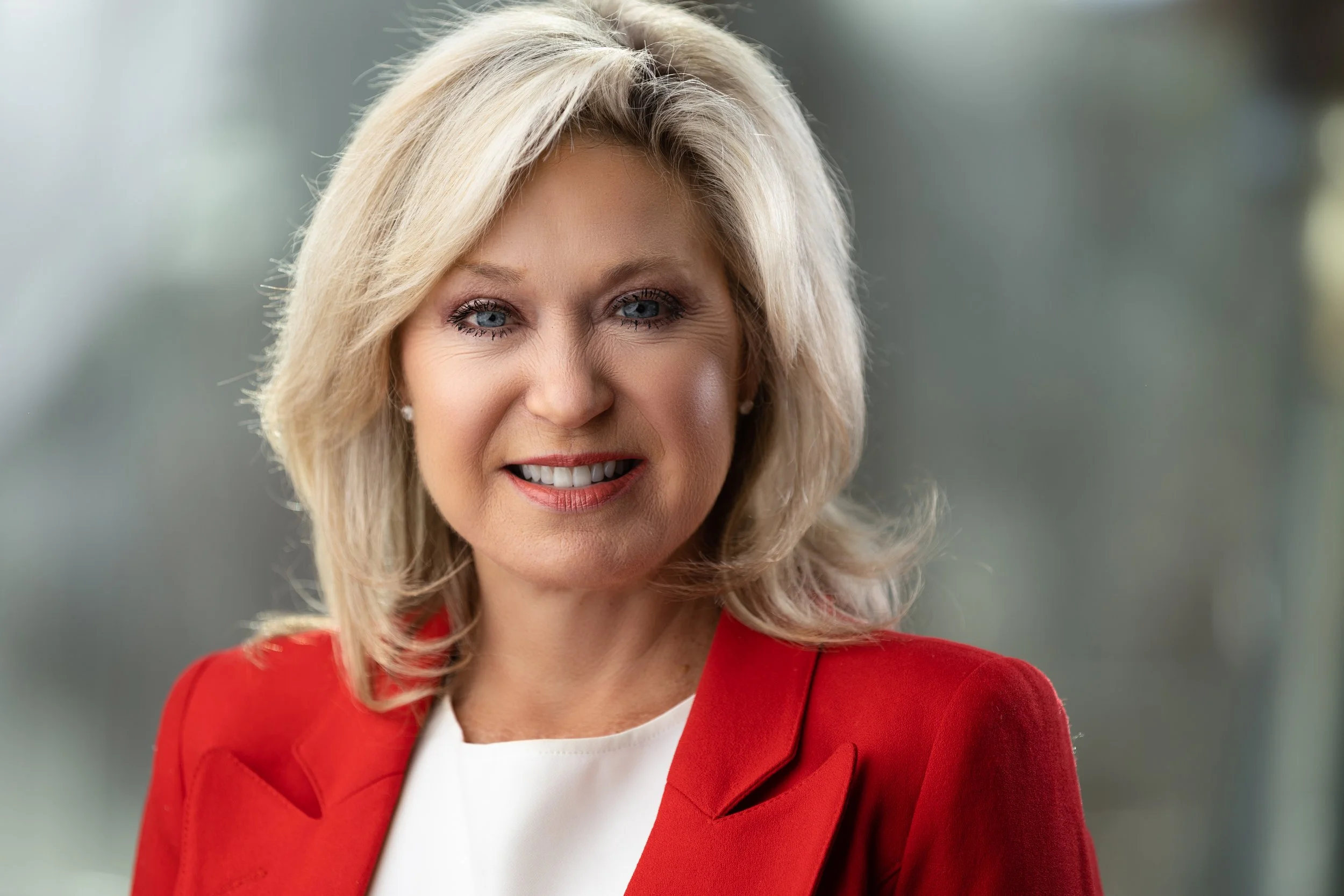
When a sitting political leader books a portrait session, the image isn't for them. It's for the constituent who will scroll past it on a phone, for the journalist who will pull it for a deadline at 11 p.m., for the rival campaign's research team, for the billboard you may never see, for the voter who has 200 milliseconds to form an impression. A corporate headshot needs to work in one place: LinkedIn. A political portrait needs to work everywhere, simultaneously, often for years, and frequently in contexts you don't control.
That's the problem I think about when a campaign team calls. And it's the problem I was thinking about the morning Bonnie Crombie, Leader of the Ontario Liberals and the former three-term Mayor of Mississauga, came through my studio doors in Oakville.
Chapter 01What political portraits actually have to do
A good portrait of a political leader has to communicate several things at once, and they don't always pull in the same direction.
It has to read as authoritative, so the viewer trusts that this person can lead. It has to read as approachable, so the viewer understands that this person is not above them. It has to read as honest, so the viewer feels there is no edit, no varnish, no spin between them and the subject. And it has to do all of this without looking like it's trying to do any of it. The moment a political portrait looks staged or strategic, the viewer feels manipulated, and the entire frame collapses.
Corporate headshots have it easier. A CEO portrait needs to project competence and warmth, and the audience is mostly internal: investors, partners, employees, prospective hires. The viewer arrives willing to give the subject the benefit of the doubt.
A political portrait has no such luxury. Half the audience is skeptical before the image even loads. Some of them are looking for a reason to dismiss the subject. Others are looking for a reason to trust them. The image has to survive both gazes, hold up across a billboard, a website hero, an Instagram thumbnail, and a printed pamphlet stuffed in a mailbox in February.
Chapter 02Bonnie's session, and what I was watching for
By the time Bonnie sat down in front of my camera, she had been photographed many times over the years. By campaign photographers, by news photographers, by community-event volunteers with iPhones. She had also led a city of more than 800,000 people for the better part of a decade, and was actively leading a provincial political party. None of which made the session easier. If anything, it raised the stakes.
When someone has been photographed that often, they have a default. Most public figures have a learned face, the one they switch on when a lens appears. It works. It is rarely them. With Bonnie, that wasn't the challenge. What struck me from the first frame was how naturally she stays herself in front of a camera. There is no switch. The same presence and warmth she brings to a town hall, a debate, or a kitchen-table conversation is the presence she brings to a portrait session. Few political leaders I have photographed make the work this easy, because few are this genuine when the camera is on.
I work with light, posture, and direction, but the actual technical setup is the least interesting part of what I do. The interesting part is the conversation between frames: what I'm asking, what I'm noticing, what I'm choosing to let breathe versus what I'm choosing to redirect. With Bonnie, the job wasn't to coax a real version of her out from behind a public-figure face. It was to read the room well enough to capture what was already there: the presence, the conviction, and a real desire to serve the public.
"Truly feels like me" is the highest compliment a political leader can give you. Because the alternative, a photo that performs leadership rather than reveals it, is the failure mode that dooms most political portraits. You can usually feel the difference within a second of looking at the image, even if you can't articulate why.
Chapter 03Four principles I bring to every political session
Authenticity and polish, together
I'm always looking to generate an image that is beautifully crafted and true to who the leader actually is. The strongest political portraits aren't the most heavily processed ones, and they aren't the most stripped-back either. They're the ones where the lighting, retouching, and direction all serve the person being photographed rather than overtake them. The result should feel polished and approachable at the same time: a leader you would trust on a billboard, a website hero, and across a coffee-table conversation.
Trust before lens
I never start a political session by picking up the camera. There is always a conversation first: about the cycle, the platform, what's coming up, what the team is worried about, what photo from the last campaign aged the best, what aged the worst. By the time the camera is in my hand, the subject knows I have read the room. That changes what shows up on the file. People look like themselves when they feel safe; they look like a brand when they don't.
Direction without performance
I direct constantly during a session: small adjustments to chin, shoulder, weight, where the eyes land. But I avoid asking the subject to perform anything. "Look strong" is a useless instruction. "Picture the moment you announced you were running, and the room went quiet" is a useful one. Specific memories produce specific expressions. Adjectives produce poses. Political portraits collapse on poses.
Multi-use thinking
Every political session I shoot covers several distinct types of imagery. We capture a clean profile headshot for the website and media, a door-hanger style shot for direct campaign material, an environmental portrait that places the candidate in a meaningful setting, and often images of the politician in action: speaking, meeting constituents, working. A great political portrait isn't a single image; it's a system. The team needs flexibility, and the file has to give it to them without going back for a re-shoot in October.
Chapter 04What campaign teams get wrong
If you're a campaign manager, a comms director, or a riding-association president booking a portrait photographer this cycle, here are the patterns I see go wrong most often, across parties, across levels of government, across years.
- Booking too late. The portrait session is treated as a checkbox item right before launch, when the candidate is already exhausted, stretched thin, and out of patience for direction. A tired candidate produces a tired portrait. Book the session four to six weeks ahead of the public announcement, before the cycle has worn the candidate down.
- Not bringing the comms team to the consultation. The photographer needs to know how the image will be used before the shutter clicks once. Web, broadcast, print, social. Each shapes the framing decisions. Sending the candidate alone with no creative brief is how you end up with a beautiful photo that doesn't fit the campaign system.
- Over-styling. Heavy makeup, over-pressed wardrobe, an obvious blow-out. The image starts to read as packaged before the voter has even noticed the face. Trust the photographer, the lighting, and the candidate. Restraint always reads as confidence.
- Skipping the second look. A "casual" companion frame (looser tie, no jacket, slight smile) is invaluable for social media, op-eds, and constituent newsletters. Most campaigns book one look. The successful ones book two. The marginal cost is small; the optionality is enormous.
- Reusing photos for too long. Voters can tell the difference between a 2022 and a 2026 face. Update the portrait every cycle, every meaningful life event, and every time the candidate's role materially changes. A four-year-old photo on a current campaign reads as carelessness, even when the candidate is excellent.
Chapter 05What this means for the next person reading
If you're a candidate, an elected official, a board member, or a public-facing figure in Toronto or the GTA, and you're thinking about updating your portrait this year, the most important thing you can do is choose a photographer who understands what the image actually has to do. Not just light it competently. Understand the constituency, the cycle, the platforms it will live on, and the political weight a portrait carries when it has to outlive an announcement, a debate, a campaign, and a news cycle.
Bonnie Crombie's portrait wasn't a photo. It was a tool. So is yours.
When the next campaign team books a session with me, the conversation starts the same way it started with Bonnie: not with where they want the camera, but with where the image is going to live. The rest of the work is everything that flows from that answer.
Booking political or public-figure portraits in Toronto or the GTA?
I offer free pre-session strategy calls for political candidates, elected officials, riding associations, and campaign teams. We'll talk through the cycle, the platforms, the wardrobe, the lighting, and the timing before a shutter clicks.
Schedule a strategy call